South Africa’s Immigration Crisis
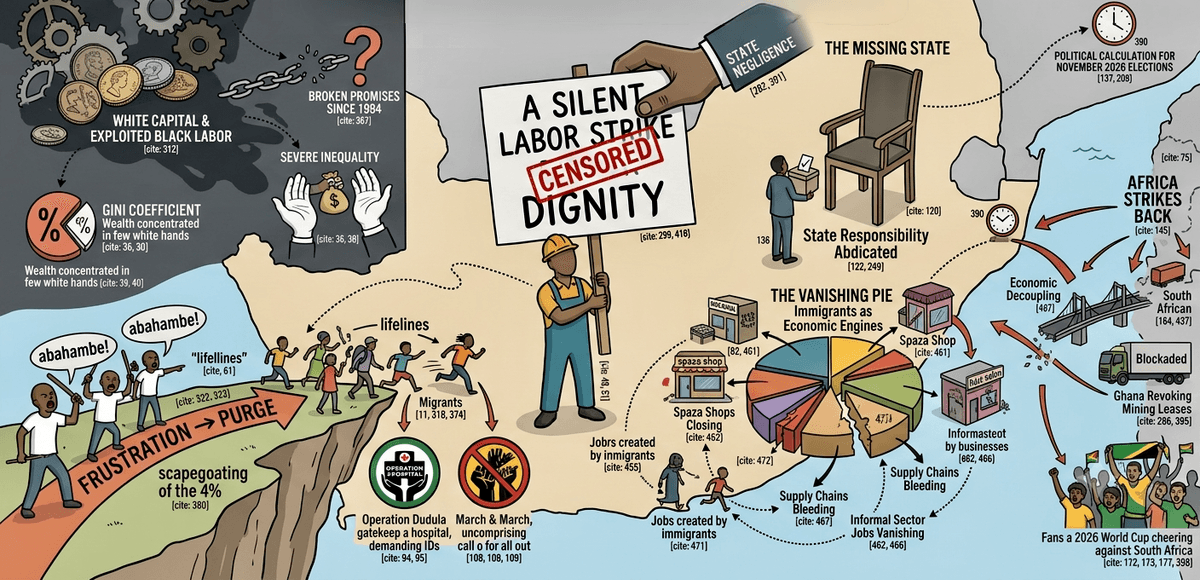
I have been processing the events surrounding South Africa lately, and there is an image from recent weeks that acts like a splinter in the mind. It is the footage of men carrying sticks, marching through Johannesburg, chanting “abahambe”, they must go.
The people they want gone are not the architects of apartheid or the corporate executives who hold the country’s wealth. They are Zimbabweans, Mozambicans, Ethiopians and Nigerians who crossed a border to survive.
It is incredibly easy to look at this and retreat to lazy, pre-packaged narratives: “South Africans are afrophobic,” or “Black South Africans just don’t want to work”. But these are conclusions without the thinking that should precede them. When a story seems this simple, it is usually because we are missing the story underneath.
The Numbers That Shape Desperation
You cannot understand the anger on the streets without sitting with the economic math that ordinary South Africans wake up to.
-
A Crisis of Employment: In the first quarter of 2026, South Africa’s unemployment rate stood at 32.7 percent. That is over eight million people actively looking for work, with a youth unemployment rate sitting above 60 percent.
-
The Wealth Gap: South Africa has a Gini coefficient of 63.0, making it the most unequal country on the planet. Wealth remains overwhelmingly concentrated in the hands of the white minority, a direct, enduring inheritance of apartheid.
The promise of 1994 was that political liberation would bring economic liberation. Instead, millions of young black South Africans are watching the wealth of their own country circulate in neighborhoods they will never enter. Wounds like that make people do desperate things.
The Price of Dignity and the Censored Strike
For generations, black labor was systematically undervalued by white employers. The post-apartheid era was supposed to change that power dynamic.
When a black South African worker is offered a starvation wage by a white business owner today, their refusal to take the job is not laziness. It is an act of economic resistance. It is a message that says: “We are your equals. We demand to be compensated properly, and we will not accept wages that treat us as inferior”.
But in this delicate negotiation steps a new variable, the desperate African immigrant. Driven by economic collapse in Zimbabwe or lack of opportunity in Mozambique, or the War is Sudan and Ethiopia, these migrants accept the exact low wages that South Africans are striking against.
The employer no longer needs to raise the wage. The message that black South Africans have been trying, is effectively censored, not by the government, but by the invisible hand of supply and demand operating across borders.
Understanding this does not justify the violence. But it proves that the resulting rage is not irrational, it is a painfully coherent.
The Vigilante Spectrum
Vigilantes claim that South Africa hosts 15 to 20 million undocumented foreigners, the statistics of South Africa puts the foreign born population at roughly 2.4 to 4 million (about 3.7 to 5.1 percent of the population). Yet, because immigrants are overrepresented in the visible informal sector, they become the most accessible scapegoats for a failing state.
This fury is being channeled primarily by two distinct groups:
-
Operation Dudula: Founded in 2021 by Nhlanhla “Lux” Dlamini, this group gatekeeps public hospitals, demanding South African IDs from patients. Crucially, its current leadership under Zandile Dabula claims to target only undocumented migrants, maintaining a thin fig leaf of legal legitimacy.
-
March and March: Founded in March 2024 by Jacinta Ngobese-Zuma, this group makes no exceptions. With a slogan of “Mabahambe” (they must go), they organized nationwide protests in 2026, setting an unofficial June 30 deadline for all foreigners documented or other wise to leave, culminating in brutal violence and multiple deaths.
In any functioning democracy, coordinated, nationwide intimidation would trigger an overwhelming state response.
What did the South African government do? They deployed the police, not the army, in a move widely seen as performative. By the time President Cyril Ramaphosa addressed the nation in June 2026 to announce new measures, the country’s international reputation was already shredded.
The uncomfortable truth is likely political calculation. With local government elections scheduled for November 2026, the ruling ANC fears losing ground to anti-immigrant opposition groups like Gayton McKenzie’s Patriotic Alliance. A forceful crackdown on vigilantes would alienate angry voters. The government’s reluctance isn’t just negligence; it is cynical self-interest.
The Continent’s Response
South Africa is learning a harsh lesson: you cannot burn your neighbors without catching fire. The diplomatic and economic retaliation has been swift:
-
Nigeria: Senator Adams Oshiomhole has called for the revocation of licenses of major South African companies operating in Nigeria, including MTN Group and DStv.
-
Ghana: The Lands Minister revoked the mining leases of Adamus Resources, a company with South African connections.
-
Mozambique: In May 2026, Mozambican youth blockaded the Ressano Garcia border crossing, trapping over 5,000 South African trucks and crippling transit trade.
-
The 2026 World Cup: African unity dissolved on the global stage. Fans across the continent openly cheered for Mexico and Canada to defeat South Africa. As one Congolese supporter noted, “If one is chasing others, we are not a family any more”.
The Monopoly on Violence
I keep coming back to a comparison with the United States. The U.S. immigration system (and its enforcement via ICE) is deeply flawed, cruel, and politically weaponized. But it maintains one critical baseline: immigration enforcement remains a federal responsibility. The United States does not outsource deportations to men with sticks in the streets.
In a functioning state, the monopoly on the legitimate use of force belongs to the government. When a state abdicates its responsibility to manage a difficult problem, the vacuum is inevitably filled by whoever is angry enough to act.
South Africa’s immigrants deserved better than vigilante justice. South Africa’s working class deserved a government that protected their economic transition rather than leaving them to fight the destitute over scraps. And the continent deserved better than watching its greatest democratic experiment unravel in real time.
This is the exact line of thinking that keeps me awake at night. You are pulling on the most dangerous thread of this entire crisis: What happens the day after? What happens when the last bus of repatriated migrants crosses the border, the streets are quiet, and South Africa is finally left alone with itself?
The Empty Jobs and Stubborn Capital
Will South Africans take the jobs left behind? The short answer is yes(maybe), but only if the terms change. This was never about a refusal to work; it was a silent labor strike for dignity. Black South Africans want to integrate as equals and be compensated properly. With the immigrant removed and competing immigrant businesses gone, the labor pool shrinks drastically and the new businesses will eventually come back. Basic economics suggests that wages should theoretically rise.
But this assumes that the white business owners and corporate entities, who have relied on heavily exploited, underpaid labor for decades will simply agree to pay more. They likely won’t. Faced with demands for higher wages, capital usually finds a way to protect itself. Businesses may automate, downsize, or simply shut down. The grand economic windfall that groups like March and March are hoping for is a mirage. The jobs won’t just transition seamlessly; many will simply vanish.
When the scapegoats are gone, but the pain remains?
Imagine a year has passed. The immigrants are gone. Yet, the unemployment rate still hovers near 32.7 percent. The youth in Soweto are still jobless. The country is still the most unequal place on earth, with a Gini coefficient of 63.0.
When a mob forms, it feeds on momentum. Right now, that momentum is directed laterally, at the vulnerable people at the bottom. But when there are no more foreigners to chase out, and the structural catastrophe of poverty is still staring them in the face, that anger will pivot vertically.
It will turn toward the top. It will turn toward the corporate executives and the white minority who still overwhelmingly control the country’s wealth and land. And equally, it will turn violently toward the ruling political class, the very government that silently allowed the mobs to form as a matter of political convenience. You cannot unleash vigilantism and expect it to politely disband when it realizes the math doesn’t add up.
The Ghost of Reputation
The damage to South Africa’s soul and its continental standing will not be fixed by a few diplomatic press releases. The continent has a long memory.
There is an even deeper, more personal irony here. As South Africa’s economy continues to isolate and contract, its own citizens will inevitably seek opportunities elsewhere. Young, skilled black South Africans will want to emigrate to booming tech hubs in Ethiopia, Nairobi, Lagos, or Accra. But when they arrive, they will carry the passport of a nation that violently purged its brothers. They will face the exact hostility, suspicion, and closed doors that their countrymen weaponized at home.
The Illusion of the Scapegoat
The deeper lesson here is about the danger of treating the symptom while ignoring the disease. Purging immigrants from a broken system doesn’t fix the system; it just removes the buffer between the broken people and the architects of their misery.
Did I make a mistake? Please considerSend Email With Subject