The Circle Of Violence
I have thought about this problem for some time, and it still quietly bothers me.
I’m Ethiopian. For as long as I can remember, I’ve watched my country tear itself apart on a loop. I’ve watched neighbors who share the same language, religion, and blood find completely rational-sounding reasons to kill each other. For a long time, I thought this was a failure of leadership or a series of tragic, isolated events.
But the mental model that finally made it click for me is much more uncomfortable: Violence in Ethiopia isn’t a random event. It is an inherited.
It’s a recursive loop. We don’t pass it through our DNA; we pass it through our storytelling, our grievances, and the very architecture of how we define our identities. If you look closely at our history, you realize that the oppressed rarely escape the system when they gain power. They just change permissions. The colonized becomes the colonizer. The revolutionary becomes the tyrant. And once you see the architecture of this loop, you can’t unsee it.
Here is how the system was built, link by link.
1. The Empire
Modern Ethiopia was built the way most states were: through conquest. In the late 19th century, a succession of northern emperors, most notably Menelik II, centralized authority by subjugating independent kingdoms in the south, east, and west.
They introduced the gibir system (Taxing System), essentially reducing self-governing populations to landless serfs forced to provide labor to northern settlers. The empire was built on dispossession, and the Amhara and Tigrayan elites became the archetypal oppressors in the eyes of the conquered. That memory of humiliation was passed down, becoming the seed for every subsequent crash.
2. The Foreign Exploit
When Italian Fascists invaded in 1935, they knew they couldn’t defeat a united Ethiopia, we had already beaten them at Adwa in 1896. So, they introduced a new framework to deconstruct that unity.
They looked at our complex, messy history and flattened it into a binary: Oppressor vs. Oppressed. They singled out the Amhara as the historical colonizers and everyone else as the victims. The Italians were eventually kicked out, but their narrative framework stayed. It was absorbed by emerging ethnonationalist groups. We took the language of division introduced by a foreign enemy and adopted it as our own political compass.
3. Vengeance as Statecraft
In 1974, a Marxist military council called the Derg hijacked a popular uprising and overthrew the emperor. They didn’t just kill the old system; they annihilated an entire generation of educated Ethiopians in the “Red Terror.”
The Derg turned vengeance into policy. The opposition responded with bombings and assassinations of their own. It was what Albert Camus called “gangster morality”, an endless, bloody pendulum of triumph and revenge. The system didn’t change; it just got more lethal.
4. Ethnic Federalism
In 1991, the Derg was finally overthrown by the Tigray People’s Liberation Front (TPLF). The TPLF was, undeniably, a movement of the oppressed. They had lost tens of thousands of fighters and civilians to the Derg’s brutality.
But here is where the logic of power reveals its darkest irony.
When the TPLF took over, they didn’t dismantle the oppressor/oppressed framework, they hardcoded it into the constitution. They established “ethnic federalism,” dividing the country into states based on ethnic identity. In theory, it was meant to grant self-government. In practice, it institutionalized ethnic grievance as the sole basis of political life. The marginalized Amhara were systematically suppressed, and animosity was manufactured between different groups. The oppressed had learned the exact language of their oppressors, and they spoke it fluently.
5. The Infinite Loop
Which brings us to today. In 2018, Prime Minister Abiy Ahmed came to power on a wave of anti-regime protests, breaking the TPLF’s grip. We felt a brief moment of euphoria.
Then the system executed the same loop. The bloodiest war broke out in Tigray, marked by summary executions and horrific violence. Today, we are fighting again, this time involving Amhara guerrilla forces. The variables change, the regions, the acronyms, the leaders, but the underlying function remains exactly the same.
We have weaponized our diversity. We’ve turned differences into divisions, and divisions into hatred. And we are teaching it to our kids.
The Trap of Liberation
Here is the deeper lesson that has shifted how I view not just politics, but human nature and conflict resolution: When you have been oppressed, liberation feels like the right to do exactly what was done to you.
The TPLF didn’t think they were oppressors; they thought they were liberating their people. The Oromo liberation movements believe they are fighting for freedom. The Amhara militias believe they are preventing their own annihilation.
Every single side has a perfectly rational, historically backed grievance. They can point to real injustices and the bodies of their dead. But when every grievance is sanctified, justice just becomes a justification for trauma.
So how do you actually fix a system this broken?
In two neighboring districts, Afar and Oromia, there is a generations-long cycle of “tit-for-tat” ethnic killings. Recently, a peace project forced these communities to sit in a room together. One father of eight, who had been actively preparing his sons for war, had an epiphany. He said: “I realized that by teaching my sons to hate, I was ensuring they would never live safely. Just as I had been taught… I was passing down the idea of war, not a way of life.”
That right there is the only way out.
The first step to solving an impossible problem is recognizing that the mental model you inherited is broken. We have to realize that bearing the memory of what was done to you does not mean you have to become the one who does it.
The ultimate solution, i believe, isn’t another military victory. It’s forgiveness. Not the cheap kind, or the friendly kind of forgiveness, but the agonizing, system breaking kind that recognizes the humanity of someone who hasn’t recognized yours. It requires the courage to stand in the middle of the loop and say: “I will not pass this on. The cycle ends with me.”
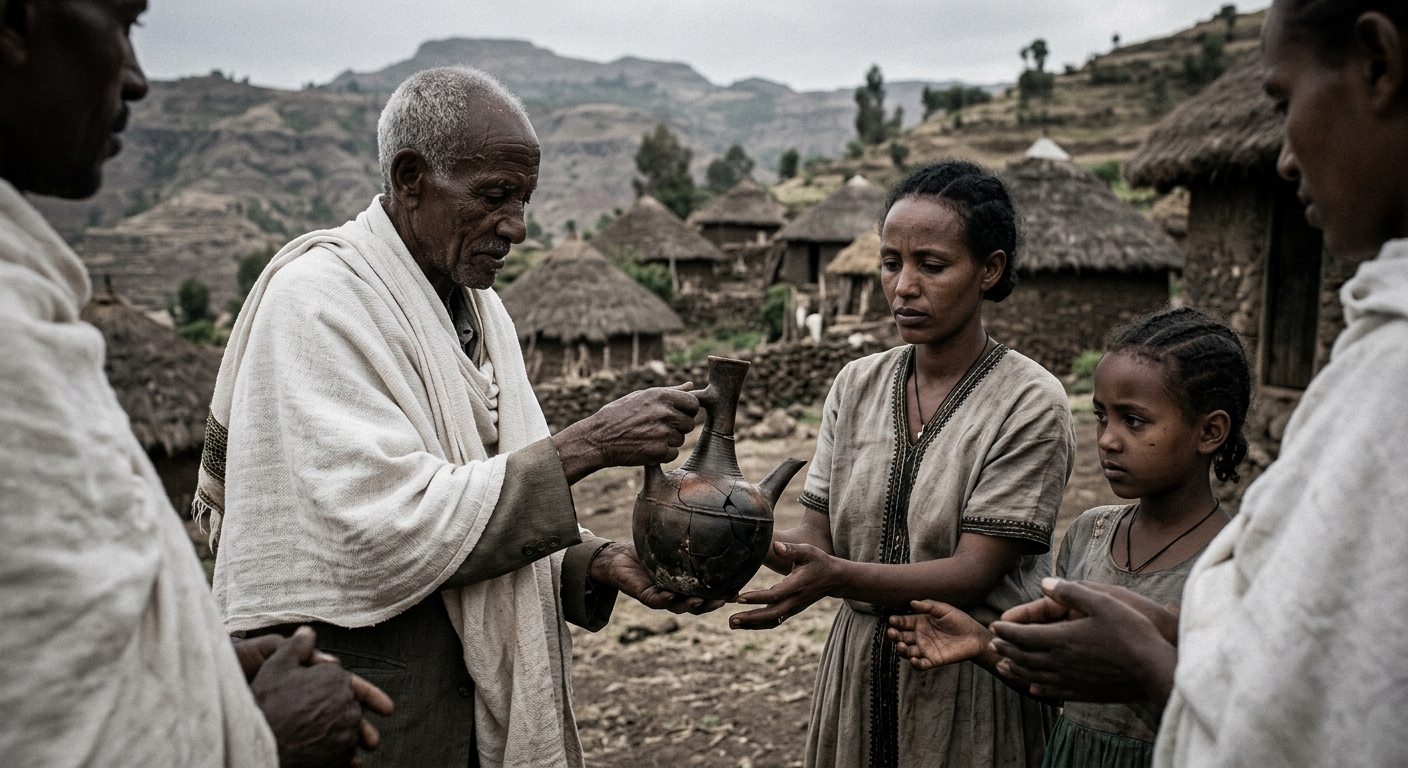
We don’t even have to look far for the blueprint, it’s already embedded in our own soil. Look at the Gamo people of southern Ethiopia. For generations, they’ve practiced a form of conflict resolution through the Dubusha, an open air assembly held beneath sacred trees, guided by customary laws (Dere Woga). Their framework doesn’t focus on punitive incarceration or violent retribution; it prioritizes confession, emotional healing, and restoring communal balance. When someone who has committed a wrong even an oppressor wants to ask for forgiveness, they approach carrying fresh green grass. The grass is a quiet, powerful symbol of life, renewal, and peace. It’s an act that strips away pride, and in response, the community grants forgiveness instead of demanding blood. It is living proof that restorative reconciliation, which isn’t a foreign ideal.
I don’t have this perfectly figured out yet. I’m still disappointed, and I’m still grieving for my country. But I’m writing this because clarity comes through the act of laying it all out. History tells us that violence is human nature. But we are also the architects of our own systems.
We can choose to be what was done to us, or we can choose to build something else.
Did I make a mistake? Please considerSend Email With Subject